Why 68% of Indian Women Employees Feel Unsafe During Their Commute — And What HR Can Do About It
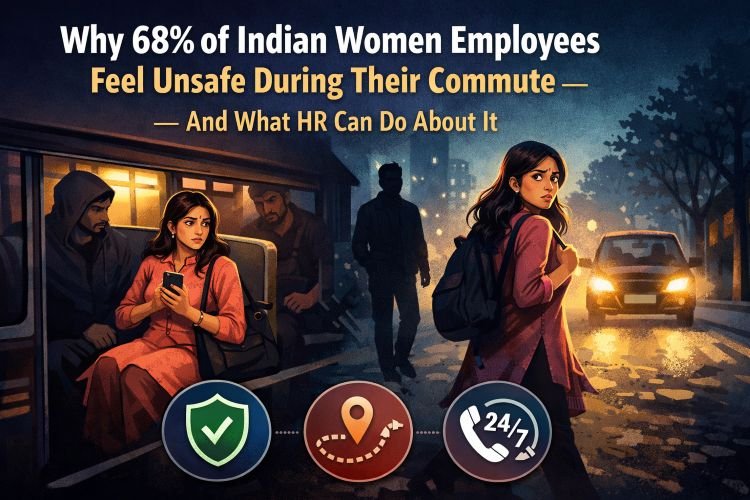
Your employee left the office at 8:45 PM yesterday. She booked a cab, waited alone in the parking lot, and sent a "reached safely" message to her family at 10:12 PM. That message was her safety system. Not yours.
This is the daily reality for millions of women professionals across Indian cities — and it plays out silently, outside the walls of your workplace, beyond the reach of your POSH policy, and invisible to your incident register.
The data, however, is not silent.
India’s National Annual Report and Index on Women’s Safety (NARI) 2025 — the most comprehensive urban women’s safety survey conducted in the country — found that despite years of interventions, four in ten women in urban India still do not feel safe in their own cities.
For HR leaders and CHROs, this number is not a government statistic. It is a daily attendance issue, a retention issue, a performance issue, and increasingly, a legal liability issue.
This article breaks down what the data actually says, why commute and after-hours safety is squarely an employer’s responsibility under Indian law, and what forward-thinking HR teams are doing about it right now.
The Data Every HR Head Needs on Their Desk
The NARI 2025 report — published by the National Commission for Women and developed by The NorthCap University and Jindal Global Law School — surveyed 12,770 women across 31 cities. Here is what it found about the environment your employees commute through every day.
| Finding | Data | Source |
|---|---|---|
Women who feel ‘not safe’ or ‘unsafe’ in their city |
40% | |
Women who experienced harassment in public spaces in 2024 |
7% | |
Harassment rate for women aged 18–24 specifically |
14% | |
Public transport flagged as top harassment hotspot |
29% | |
Neighbourhoods around workplace flagged as hotspot |
38% | |
Harassment incidents that go unreported |
2 in 3 | |
Women who trust authorities to act on their complaint |
Only 25% | |
Women choosing ride-hailing over public transport — citing safety |
75% | |
Increase in crime rate against women (India, 2018–2022) |
+12.9% |
NARI 2025 full overview — Outlook India | Detailed breakdown — Khan Global Studies | Shankar IAS Parliament summary
The 14% harassment figure for women under 24 is the number that should alarm every HR team. These are your new joiners — your freshers, management trainees, BPO executives on the night shift. They face twice the risk of their senior colleagues. And they are the least likely to report it.
Two-thirds of harassment incidents go unreported. NCRB data misses the majority of cases.
NARI 2025 — National Commission for Women [Source: https://www.shankariasparliament.com/current-affairs/national-annual-report-and-index-on-womens-safety-nari-2025]
Read that again. The official crime data — the data that informs government policy and corporate risk assessments — captures only one in three incidents. The scale of the problem around your office, on the routes your employees take home, is likely three times larger than any published figure suggests.
Where the Danger Actually Lives: The Commute Risk Map
When HR conversations turn to commute safety, they almost always jump to cab aggregator policies or drop-and-pick guidelines. That addresses one sliver of the risk. The reality is more granular.
The 2024 Karnataka High Court ruling in Ms (X) vs ICC held Ola Cabs accountable under the POSH Act for driver misconduct — establishing that platform companies can be treated as employers under specific circumstances and that liability can follow an employee into a moving vehicle. The commute is no longer legally off-limits.
Where the Danger Actually Lives: The Commute Risk Map
Based on NARI 2025 findings and 25 years of field experience training corporate employees across India, risk concentrates in four specific windows:
- The last-mile gap. The 200–500 metre stretch between the cab drop-point, metro exit, or auto stop and the actual destination. Static data from NARI 2025 confirms neighbourhoods (38%) are the top-cited hotspot — meaning this final stretch, not the vehicle itself, is the highest-risk segment.
- The waiting window. Standing alone at a pickup point, in a mall entrance, or in an office parking lot after dark. Low light, no witnesses, unpredictable dwell time.
- Shared vehicle scenarios. Cab pools and shared autos with unknown co-passengers. Following the Ola ruling, employer accountability in these situations is no longer theoretical.
- The night-shift exit. Employees leaving between 9 PM and midnight — standard in IT, BPO, banking operations, and hospital settings — face the highest composite risk across all four factors simultaneously.
The risk does not begin when the employee enters the cab. It begins the moment she leaves the building. And the employer’s duty of care does not end at the door.
Arvind Khaire, Founder, CTS CorpDefence
NARI 2025’s finding that public transport (29%) and neighbourhoods (38%) are the two top-cited harassment hotspots confirms this. It is the space between the transport and the destination — not the transport itself — where women are most exposed.
This Is Not Just an Ethical Issue. It Is a Legal One.
Indian law is unambiguous about employer responsibility for women’s safety — and the scope of that responsibility extends well beyond your office premises and well beyond the POSH Act.
What the Law Actually Requires
- Factories Act 1948, Sections 35 & 87: Employers must provide instruction, training, and supervision necessary to ensure safety. Special security arrangements are mandated for women working night shifts, including transport protocols.
- Occupational Safety, Health and Working Conditions Code 2020: Employers carry a positive duty to ensure health and safety of all employees — including through structured training.
- Ministry of Labour & Employment Advisory, January 2024: Explicitly requires employers to arrange transportation and safety measures for women on night shifts and to obtain documented consent before assigning them.
- POSH Act 2013: Requires an Internal Complaints Committee accessible to all women employees — and, per recent judicial interpretation, to those in transit on company business.
- Bharatiya Nyaya Sanhita 2023, Sections 74 & 79: Provides criminal remedies for assault and outraging modesty, with employer liability increasingly interpreted through case law.
- Karnataka HC — Ms (X) vs ICC (Ola Cabs), 2024: Platform companies can be treated as employers under specific circumstances; sets precedent for transit accountability.
Safety affects every aspect of a woman’s life — her education, health, work opportunities, and freedom of movement.
NCW Chairperson Vijaya Kishore Rahatkar, at the launch of NARI 2025 [Source: NCW / NARI 2025]
The direction of legal travel is clear: employer accountability is expanding, not contracting. The question is no longer whether your company is liable. It is whether you have taken demonstrable steps to discharge that liability.
A documented, expert-delivered safety training programme — with attendance records, feedback scores, and participation certificates — is precisely that demonstrable step.
HR teams across India use CTS CorpDefence workshops as a documented duty-of-care measure. See the Workshop Format →
Why Policies Alone Are Not Enough
Most medium and large Indian corporates have some version of a women’s safety policy. Many have POSH committees, cab booking guidelines, and night-shift protocols. And yet the NARI 2025 report found that 53% of women were unclear whether their workplace even has a POSH policy. That is not a policy problem. That is a culture and training problem.
| What Policies Provide | What Training Provides |
|---|---|
Rules to follow after an incident |
Instincts to prevent the incident |
A number to call when it happens |
Skills to respond in the moment |
Compliance documentation |
Actual behavioural change |
A grievance process |
Situational awareness before it escalates |
HR confidence |
Employee confidence |
Policies govern what happens after something goes wrong. Training changes what happens before. Both are necessary. Only one is currently standard practice in most Indian corporate safety programmes.
This is the gap that corporate self defence training fills — and it is a gap that remains invisible until the day it isn’t.
What Practical Safety Training Actually Looks Like
The instinctive HR response to commute safety is to issue guidelines: book only verified cabs, share your live location, avoid isolated areas. These are not wrong. They are just insufficient. The CTS CorpDefence methodology — developed over 25 years of field research specific to Indian conditions — covers what guidelines cannot:
1. Situational Awareness
Most incidents are preventable at the threat-recognition stage, not the physical confrontation stage. CTS trains employees to read their environment accurately — the parking lot at 9 PM, the elevator with an unknown co-passenger, the cab that takes an unexpected route — and to make fast, low-drama decisions before a situation escalates.
2. Verbal De-escalation
The vast majority of threatening situations encountered by working women in India involve verbal aggression, boundary testing, or intimidation — not physical assault. Assertive communication, boundary-setting language, and psychological confidence under pressure are teachable skills that work in office clothing, in a moving vehicle, in a crowded metro.
3. The 3-Layer Model: Avoid → Neutralize → Fight
The CTS framework is explicit about priorities. Physical self defence is the last layer, not the first. The first layer is avoidance — intelligent route choices, time choices, and environmental reading. The second is neutralisation — verbal, psychological, and positional tactics that resolve threats without physical contact. Physical skills are the third layer, reserved for genuine last-resort scenarios.
This is a framework that a 55-year-old finance director and a 23-year-old management trainee can both internalize and apply — without any martial arts background. Read more about the CTS methodology →
4. Everyday Objects as Safety Tools
One of the most impactful CTS session elements: teaching employees how objects already in their bag — a pen, keys, a water bottle, a laptop bag strap — can function as deterrents and defensive tools in extremis. Practical, memorable, and deeply reassuring for employees who have assumed self defence requires physical size or strength.
From case studies to practical tips, it was a brilliant introduction to self defence for our women employees.
Anil Suryawanshi, HSSE Performance Analyst, BG Exploration & Production India Ltd.
The demonstrations on defending oneself by using one’s own body and also by utilising any available object certainly added value to all the participants.
Dinaz Shrivastava, Sr. Faculty, Tech Mahindra Ltd.
What Forward-Thinking HR Teams Are Doing Right Now
Across 300+ corporate organisations trained by CTS CorpDefence — spanning BFSI, IT/BPO, pharma, oil and gas, and manufacturing — the HR teams that act early share a few common characteristics.
They schedule before the incident, not after.
The most effective programs are not crisis responses. They are planned into the L&D calendar alongside other wellbeing initiatives — often tied to Women’s Day (March 8), National Safety Week (March 4–10), or Q3 appraisal cycles when retention conversations peak.
They use it as a retention signal.
In a competitive talent market, demonstrable investment in women’s safety is a retention and recruitment differentiator. The Uber–Oxford Economics report found that four in ten working women said access to safe mobility enabled them to join the workforce at all. A company that actively trains its women employees in safety skills communicates something no benefits brochure can replicate.
They go beyond the 1-hour awareness session.
The 1-hour orientation has its place — for onboarding, all-hands events, and leadership sensitisation. But the organisations with the strongest safety cultures pair it with a 3-hour hands-on workshop for at-risk teams (night-shift staff, field sales, outstation travel roles) and a full-day program for high-risk departments.
They tie it to CSR and POSH documentation.
Under the CTS PowerWithin initiative, organisations can access CSR-linked programs that simultaneously address women’s empowerment objectives and provide documented evidence of proactive safety training — directly relevant to POSH audits and ESG reporting frameworks.
The 5-Point Commute Safety Action Plan for HR Leaders
If you are a CHRO, HR Director, or L&D Head, here is a practical starting point — not aspirational policy language, but specific actions with supporting legal context.
- Audit your actual exposure. Survey your women employees anonymously about their commute experience. Ask specifically about the time of their return journey, mode of transport, and whether they have ever felt unsafe. The NARI 2025 national average¹ is 40% — your numbers may be higher.
- Review your legal obligations beyond POSH. The Factories Act 1948⁷, the OSH Code 2020⁵, and the Ministry of Labour’s January 2024 Advisory³ all impose specific duties around women’s safety in extended hours. If you have women on night shifts and no documented transport and safety protocol, you are already non-compliant.
- Schedule a structured safety training workshop. Not a webinar. Not a pamphlet. A live, scenario-based, expert-led session that your employees can feel and remember. The format — 1-hour, 3-hour, or full-day — depends on your team’s exposure level. Explore CTS workshop formats →
- Extend the safety perimeter beyond your gate. Train employees on the last-mile gap, waiting scenarios, and shared vehicle situations. That is where the NARI data tells us the risk actually concentrates.
- Document everything. Attendance records, participant feedback, satisfaction scores, and participation certificates are your evidence of due diligence — relevant to POSH compliance, ESG audits, and any future legal scrutiny. CTS provides all of these as standard.
40%
of women in Indian cities consider themselves ‘not safe’ or ‘unsafe’
About the Author

Arvind Khaire
Is Your Team Prepared?
Book India’s most trusted corporate self defence workshop. 1-hour, 3-hour, or full-day. Pan-India delivery. No gym or equipment required.
Further Reading on safe-t-guru.com
- Why Corporates Choose CTS — The case for reality-based corporate training over generic safety awareness
- The CTS Self Defence System — Methodology, research base, and how it differs from martial arts training
- Women’s Safety at the Workplace Program — Dedicated women’s safety workshops for corporate teams
- About Arvind Khaire — 25 years of field research, national awards, and media recognition
- CTS in the Press — Times of India, Indian Express, Free Press Journal, Education Times
Sources & References
[1] National Annual Report and Index on Women’s Safety (NARI) 2025, National Commission for Women — survey of 12,770 women across 31 Indian cities. Outlook India coverage
Also available via: Khan Global Studies | Shankar IAS Parliament | NCW Official Site
[2] Uber & Oxford Economics — Women’s Workforce Participation and Safe Mobility in India (2023). Key finding: 75% of women choose ride-hailing over public transport citing safety; 4 in 10 working women said safe mobility enabled them to join the workforce. Business Standard coverage
[3] Ministry of Labour and Employment — Advisory for Employers to Promote Women Workforce Participation (January 30, 2024). Mandates transport, safety measures, and documented consent for women on night shifts. Lexology legal analysis
Official ministry site: labour.gov.in
[4] Sexual Harassment of Women at Workplace (Prevention, Prohibition and Redressal) Act, 2013 (POSH Act) — mandates Internal Complaints Committee, extended through judicial interpretation to transit scenarios. India Code (official)
Applied context: KS&DK legal overview
[5] Occupational Safety, Health and Working Conditions Code, 2020 — positive duty on employers to provide safety training and supervision; mandates transport and rest facilities for women in all sectors including night shifts. Tax Guru explainer
Additional reference: Paycheck.in employer obligations
[6] Bharatiya Nyaya Sanhita (BNS) 2023 — Section 74 (assault or criminal force to outrage modesty) and Section 79 (word, gesture, or act to insult modesty of a woman). Increasingly applied in workplace and transit contexts. India Code (official BNS text)
Workplace application context: KS&DK analysis
[7] Factories Act 1948 — Sections 35 & 87. Mandates employer training and supervision for safety; special security protocols for women on night shifts including transport facilities. Paycheck.in reference
Employer guide: Lexology employer rights overview
[8] Karnataka High Court — Ms (X) vs ICC (Ola Cabs), 2024. Ruling held cab aggregator accountable under POSH Act for driver misconduct. Established precedent: platform companies can be treated as employers; liability extends into transit. YourStory coverage